
Types of Pools: Above-Ground, Inground, and Semi Compared
Above-ground, semi-inground, and inground vinyl, fiberglass, and gunite pools compared by installed cost, lifespan, and who each type suits best.
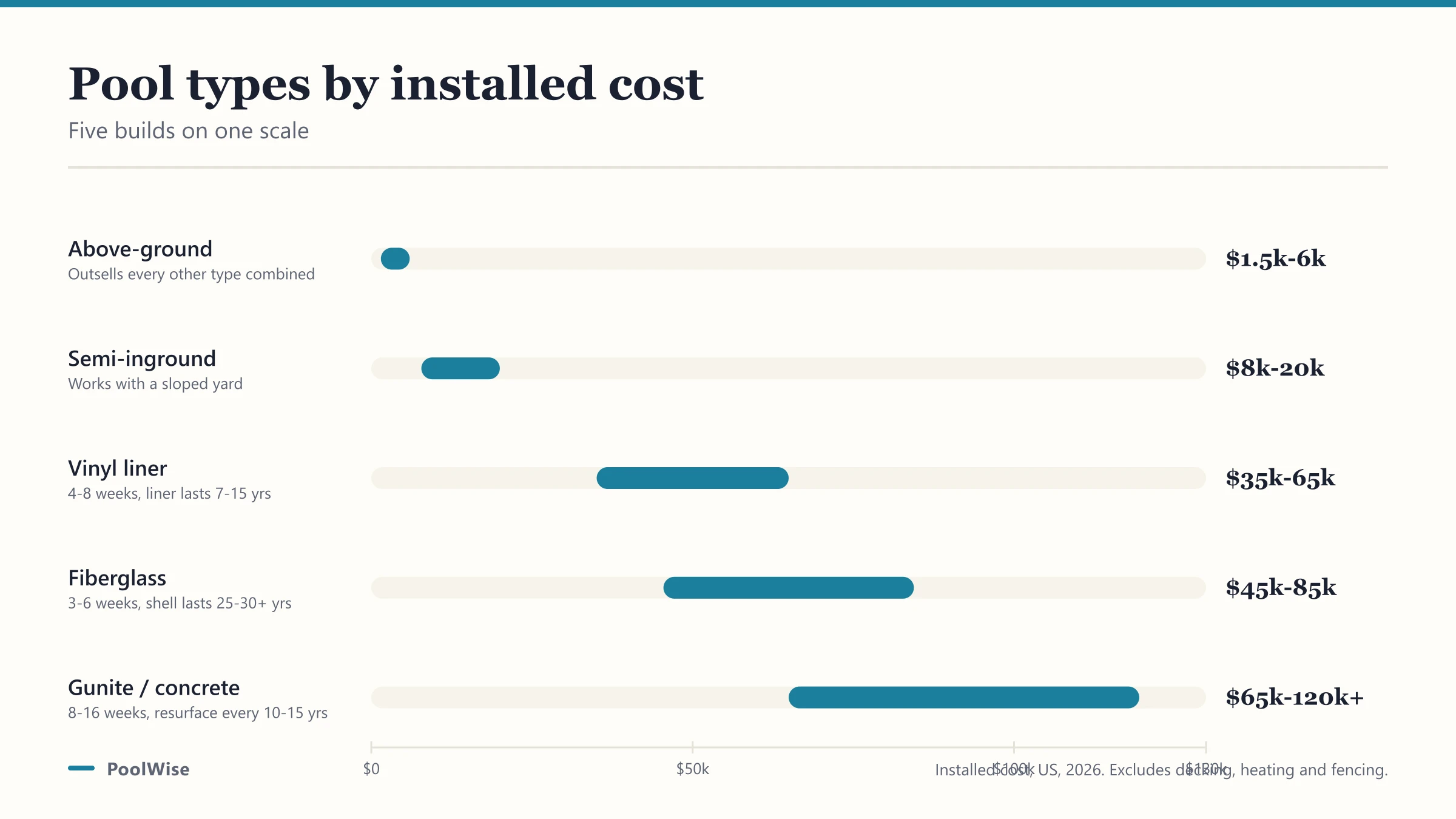
Pick a pool type before you pick a pool, because the type decides almost everything else: what you’ll pay, how long it lasts, and how much upkeep it demands. Five builds cover the entire market, and they split into three cost tiers that rarely overlap.
What are the main types of pools?
Every residential pool sold today is one of five types: above-ground, semi-inground, or one of three inground builds, vinyl liner, fiberglass, or gunite/concrete. Above-ground pools sit entirely on top of the yard inside a metal, resin, or hybrid frame. Semi-inground pools are partially recessed, often built into a slope with a retaining wall holding back the exposed side. Inground pools are fully excavated, and the three inground types differ in what lines the hole: a vinyl sheet over a wall structure, a one-piece fiberglass shell, or sprayed gunite or poured concrete finished with plaster, pebble, or tile.
Above-ground pools: cost and lifespan
Above-ground pools install for $1,500 to $6,000 fully set up, which is the entire reason they outsell every other type combined. A 15-foot round pool holds about 5,300 gallons, an 18-foot round about 7,600 gallons, and a 24-foot round about 13,500 gallons. A 12x24 oval runs about 6,800 gallons. Liners typically need replacing every 7 to 15 years, and the pool itself rarely outlasts 15 to 25 years before the frame or walls need replacing. Annual upkeep runs $600 to $1,200. For the full buying breakdown, including deck options, see our above-ground vs inground comparison.
Semi-inground pools: the middle ground
A semi-inground pool splits the difference: part of the wall sits above grade, part is recessed into the yard, usually to work with a slope that would be expensive to grade flat for a fully inground build. Installed cost runs $8,000 to $20,000, well above an above-ground pool but a fraction of any inground option. The look reads as more permanent than above-ground, and the recessed portion needs the same wall and liner materials as an above-ground pool, so lifespan expectations are similar, generally 15 to 25 years before major component replacement.
Inground pools: vinyl, fiberglass, and gunite compared
The three inground types share full excavation but differ sharply on cost, install time, and lifespan.
| Type | Installed cost | Typical build time | Shell lifespan |
|---|---|---|---|
| Vinyl liner | $35,000-$65,000 | 4-8 weeks | Liner: 7-15 yrs; structure: 20+ yrs |
| Fiberglass | $45,000-$85,000 | 3-6 weeks | 25-30+ yrs (gelcoat resurface as needed) |
| Gunite/concrete | $65,000-$120,000+ | 8-16 weeks | 20-30+ yrs (plaster/finish resurface every 10-15 yrs) |
A typical residential inground pool holds 18,000 to 20,000 gallons; a small 12x24 build runs closer to 9,700 gallons and a large 20x40 build closer to 26,900 gallons, both at a standard 3-foot shallow to 6-foot deep slope. Fiberglass installation is fastest because the shell arrives pre-molded; gunite and concrete takes longest because the shell is built and cured on site, but it’s also the only type that lets you build almost any shape.
Which pool type lasts the longest?
Gunite and concrete wins on raw structural lifespan, since the shell is reinforced concrete rather than a liner or molded shell. But “lifespan” and “maintenance-free” aren’t the same thing: gunite plaster typically needs resurfacing every 10 to 15 years, which is a real, recurring cost most first-time buyers underestimate. Fiberglass shells resist algae growth better and need less frequent chemical correction, which is why many owners report lower year-to-year hassle even though the upfront cost sits between vinyl and gunite. Vinyl liners are the shortest-lived single component of any pool type, needing replacement roughly every 7 to 15 years regardless of whether the pool is above-ground, semi-inground, or inground.
How does your yard and climate affect the choice?
A sloped lot changes the math more than any other single site factor. Fully inground pools on a slope need either expensive grading to level the site or added engineering to shore up the low side, both of which push cost toward the top of the inground range or beyond. A semi-inground build often sidesteps that cost entirely by working with the grade instead of fighting it, which is why it’s worth pricing alongside a fully inground quote on any lot that isn’t close to flat. Climate matters too, mainly through how many months a year the pool actually gets used. In a short-season climate, the lower upfront cost and easy removability of an above-ground pool carries more weight, since you’re not spreading a large fixed cost across as many swim months. In a long-season or year-round climate, the extra durability and resale value of an inground pool has more time to earn back its higher price. Soil type is a smaller but real factor: rocky or high-water-table soil adds excavation cost to any inground option and is worth testing for or asking a local contractor about before you commit to a design.
Which pool type fits your budget?
Set a number before you set a shape. Under $10,000 realistically means above-ground or a modest semi-inground build. $35,000 to $85,000 opens vinyl or fiberglass inground pools. Above $65,000, gunite and concrete become competitive, especially for custom shapes; our pool shapes guide covers which builds each shape actually requires. Whatever type you land on, budget for ongoing installation and site costs beyond the pool itself: permits, excavation or site prep, decking, and equipment pads routinely add 15% to 30% on top of the base pool price. It’s also worth pricing ongoing upkeep before you finalize a type, not after, since the gap between above-ground and inground annual costs, $600 to $1,200 a year versus $1,800 to $5,000, adds up to a meaningful difference over a decade of ownership.
Once you’ve narrowed to a type, the decision that matters most is inground versus above-ground for your specific yard and budget, covered in full in our inground vs above-ground comparison, and if your lot has any slope, the semi-inground pool guide is worth reading before you rule it out.
Frequently asked questions
Quick answers to what readers ask us most
What is the most common type of pool?
Above-ground pools are the most commonly sold new pool type in the US by unit count, mainly because the $1,500 to $6,000 installed cost puts them within reach of far more households. Inground pools cost more but dominate resale value and total pool-owning households, since older inground pools stay in the ground for decades.
Which pool type is cheapest to install?
Above-ground pools are cheapest to install, typically $1,500 to $6,000 for the pool, liner, and a basic pump and filter setup. Semi-inground pools run $8,000 to $20,000. Every inground option starts above $35,000, with gunite and concrete the most expensive at $65,000 to $120,000 or more.
Which pool type lasts the longest?
Gunite and concrete pools last the longest, often 20 to 30-plus years before major resurfacing, because the shell itself is structural concrete rather than a liner or shell that ages. See our gunite and concrete pool guide for what that lifespan costs to maintain.
Does pool type affect home resale value?
Yes. Inground pools (vinyl, fiberglass, or gunite) generally add more resale value than above-ground pools, which many buyers view as removable and short-lived. Semi-inground pools land in between, valued more like a permanent yard feature than an above-ground pool once installed correctly.