
Semi-Inground Pools: Cost, Pros, Cons, and Best Uses
What a semi-inground pool actually is, what it costs installed ($8,000 to $20,000), and when it beats above-ground and inground pools on a sloped lot.
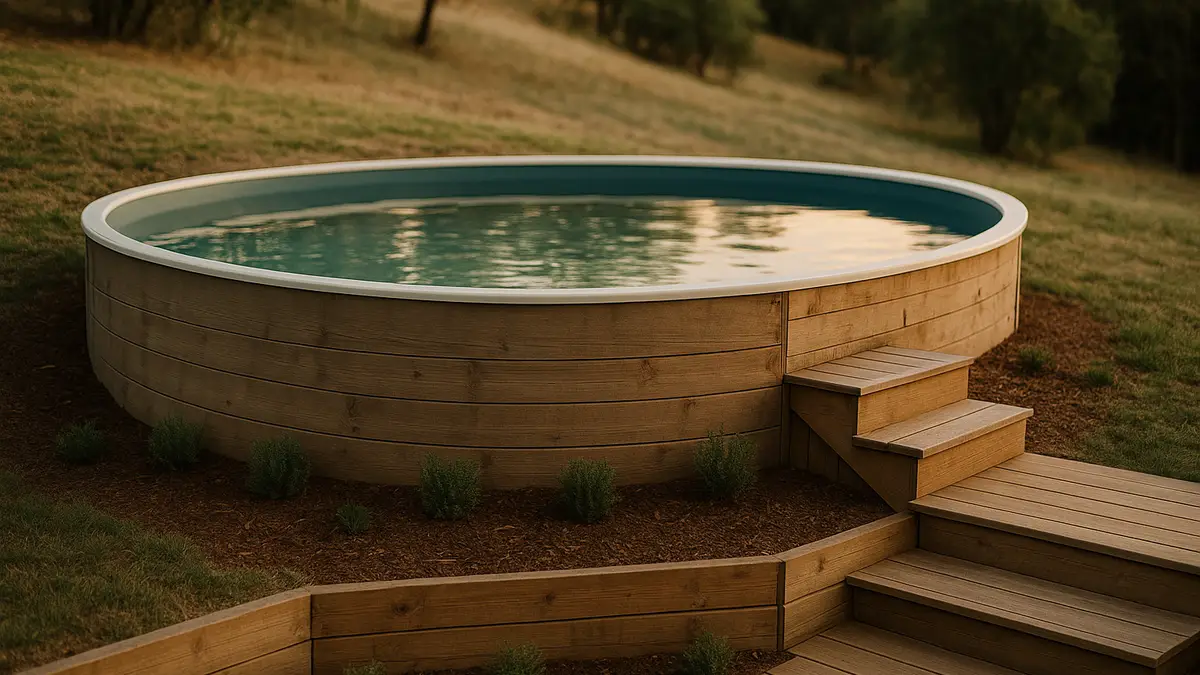
A semi-inground pool is a pool built half in the ground and half above it, and it exists for one practical reason: sloped yards make full excavation expensive, and a semi-inground build turns that slope into a shortcut instead of a cost.
What is a semi-inground pool?
A semi-inground pool uses the same wall-and-liner construction as an above-ground pool, but part of the wall sits recessed below grade instead of resting entirely on top of the yard. It’s most common on sloped lots, where one side of the pool is built into a cut in the hill and held back by a retaining wall, while the other side stays exposed above grade like a standard above-ground pool. The result looks more built-in than a standalone above-ground pool without the excavation cost of a fully inground build.
What does a semi-inground pool cost?
Installed cost runs $8,000 to $20,000, which sits squarely between above-ground ($1,500-$6,000) and any inground option (starting at $35,000). The range depends mainly on how much of the pool needs to be recessed and how much retaining-wall work the site requires. A gentle slope with a short exposed wall lands near the low end; a steeper cut that needs a substantial timber or block retaining wall pushes toward $20,000. Our semi-inground pool cost guide breaks down what drives the price inside that range.
| Cost driver | Effect on price |
|---|---|
| Slope severity | Steeper slope = more retaining wall = higher cost |
| Retaining wall material | Timber cheapest, engineered block or concrete costs more |
| Deck around exposed wall | Adds cost but is common and recommended |
| Pool size | Larger pools scale cost like any wall-and-liner build |
What are the pros of a semi-inground pool?
The main advantage is fit: a semi-inground pool works with a slope instead of fighting it, which is exactly the situation where a fully inground pool gets expensive fast, since sloped-lot excavation and engineering add cost that flat-lot inground builds don’t carry. Cost is the second advantage, landing well under any inground option while looking more permanent than a standalone above-ground pool. It also opens up yards that a standard above-ground pool wouldn’t fit into cleanly, since the recessed side can follow the grade instead of requiring a leveled pad.
What are the cons of a semi-inground pool?
Lifespan is the honest trade-off. A semi-inground pool uses the same wall-and-liner materials as an above-ground pool, so it carries the same 15 to 25 year expectation and the same liner-replacement cycle (roughly every 7 to 15 years), not the 20 to 30-plus years a gunite shell offers. Retaining-wall failure is a real risk if the wall isn’t engineered for the soil and water load behind it, which is why this is one build type worth having a structural opinion on before signing a contract, not just a price quote. It’s also a narrower-fit product: on a flat yard, it doesn’t offer any advantage over a standard above-ground pool, and on a very steep slope, the retaining-wall cost can climb high enough that a full inground build becomes competitive.
What does a semi-inground pool build process look like?
The build starts with a site survey to map exactly how much of the pool needs to sit below grade versus above it, since that split drives both the retaining wall design and the total cost. Crews then cut into the slope on the recessed side, build and back the retaining wall, and set the pool’s wall panels and liner much the way an above-ground pool goes in, just with part of the structure now sitting in an excavated cut instead of on level ground. Plumbing, a pump pad, and any deck or steps go in after the wall and liner are set, and the whole process typically runs a few weeks faster than a fully inground build since there’s far less excavation and no cured concrete shell to wait on. Because part of the job is retaining-wall construction rather than pure pool installation, it’s worth confirming your contractor has specific experience with semi-inground builds on sloped lots, not just general above-ground or inground installation experience, since the two skill sets don’t fully overlap.
How does maintenance differ from a fully inground pool?
Day to day, maintenance is essentially identical to any other pool type: the same chemical balancing, filtration, and cleaning routine applies regardless of how much of the wall sits below grade. The one semi-inground-specific item worth adding to a routine inspection is the retaining wall itself, checking for bulging, cracking, or drainage issues behind it, since a retaining wall under stress usually shows warning signs well before it fails outright. Keeping drainage clear behind the wall matters more here than on a standard above-ground pool, since trapped water behind a retaining wall adds pressure the wall wasn’t necessarily designed to hold indefinitely.
Who should build a semi-inground pool?
Owners with a sloped yard and a budget between above-ground and inground pricing are the clearest fit. It also suits anyone who wants a more finished look than a standalone above-ground pool without stretching into inground territory, and anyone planning to sell within 10 to 15 years, where the lower upfront cost matters more than the shorter lifespan. It’s a weaker fit for a flat lot (just buy above-ground) or for owners planning to stay 20-plus years in a home where a gunite or fiberglass shell’s longer lifespan pencils out better over time.
For the full cost ladder across every pool type, our pool types comparison lines up semi-inground against above-ground and all three inground builds side by side. If you’re still deciding between a semi-inground build and going fully inground, the inground vs above-ground comparison covers the decision from the other direction, and our installation cost guide breaks down what else beyond the pool itself tends to show up on the final bill.
Frequently asked questions
Quick answers to what readers ask us most
Is a semi-inground pool cheaper than an inground pool?
Yes, significantly. A semi-inground pool typically costs $8,000 to $20,000 installed, compared to $35,000 and up for any fully inground build. The savings come from far less excavation, since only part of the pool wall needs to be set below grade.
Can you put a deck around a semi-inground pool?
Yes, and most owners do, since a deck hides the exposed wall and makes the pool read as a permanent inground feature rather than an above-ground pool with extra steps. Decking adds to the total cost beyond the $8,000 to $20,000 pool price.
How long does a semi-inground pool last?
Roughly 15 to 25 years before major wall or liner replacement, similar to an above-ground pool, since semi-inground pools use the same wall-and-liner construction rather than a poured or sprayed shell. The exposed portion needs the same maintenance as an above-ground wall.
Is a semi-inground pool a good idea on a flat yard?
Usually not the first choice. Semi-inground pools earn their cost advantage on sloped lots, where the grade does part of the excavation work for free. On a flat yard, a standard above-ground pool is cheaper for the same result; see our pool types comparison for the full cost ladder.