
Pool Maintenance Cost: Real Monthly and Yearly Numbers
Pool maintenance costs $600 to $1,200 a year for above-ground pools and $1,800 to $5,000 a year for inground, broken down by chemicals, electricity, and service.
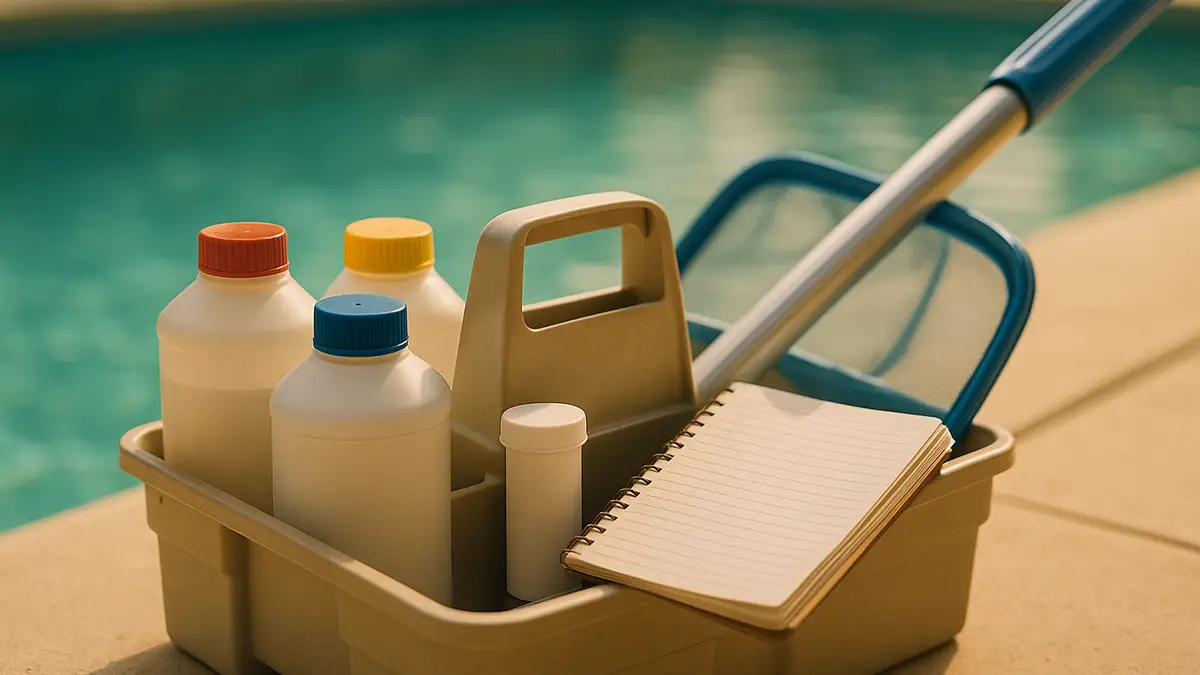
Pool maintenance cost isn’t a flat number, it’s mostly electricity and chemicals, and both scale directly with how much water the pool holds. Here’s what that actually adds up to, month by month and year by year.
What does pool maintenance cost per year?
Above-ground pools run $600 to $1,200 a year. Inground pools run $1,800 to $5,000 a year. The gap tracks water volume closely: a standard above-ground round holds 5,300 to 13,500 gallons depending on size, while a typical inground pool holds 18,000 to 20,000 gallons, more than double even the largest above-ground option. More water means more chemical volume to treat and more pump runtime to hit a standard turnover rate, cycling the full pool volume through the filter at least once every 8 hours.
What does that break down to monthly?
| Pool type | Annual cost | Typical monthly cost |
|---|---|---|
| Above-ground | $600-$1,200 | $50-$100 |
| Inground | $1,800-$5,000 | $150-$420 |
These are averages across a full season and off-season, not a flat monthly bill. Costs run highest in peak summer, when pump runtime and chemical demand both climb, and lowest in cooler months when the pump runs less and, in colder climates, the pool may be closed entirely; our opening and closing guide covers seasonal routines that affect this swing.
What makes up the annual cost?
Electricity to run the pump is typically the largest line item, since pump runtime follows a rough rule of thumb of about 1 hour per 10 degrees of air temperature, or 8 to 12 hours a day during peak summer heat. Chemicals, chlorine or salt, pH adjusters, algaecide, and shock treatments, are the second-largest cost and the one most affected by weather, since heat and heavy pool use both drive up demand. Routine service, if you hire it out rather than doing it yourself, typically adds $80 to $150 a month on top of chemical and electricity costs. Filter media and minor equipment wear round out the annual total.
How does pool type affect the number within each range?
Semi-inground pools generally land closer to the above-ground end of costs, since they use similar wall-and-liner construction and typically hold less water than a full-size inground pool; our semi-inground pool cost guide covers that build’s specific cost profile. Gunite and concrete inground pools can run toward the higher end of the inground range, since larger custom shapes and add-on features (spillways, extra circulation for tanning ledges) increase both water volume and equipment demand versus a standard rectangle.
What does a sample monthly line-item budget look like?
Take a mid-size inground pool as an example. Electricity for the pump typically runs $30 to $80 a month depending on pump type and local rates, more for a single-speed pump run long hours, less for a variable-speed pump matched to actual turnover need. Chemicals run $40 to $100 a month in-season, chlorine or salt cell maintenance, pH adjusters, and periodic shock treatments, with the higher end common during peak summer heat and heavy use. If you hire routine service rather than doing it yourself, add $80 to $150 a month for a technician to handle testing, cleaning, and dosing. Add those together and a mid-range inground pool with hired service lands around $150 to $330 a month in season, tracking closely with the $150-$420 range covered above once you count off-season months where costs drop.
Is it cheaper to do maintenance yourself or hire it out?
Doing it yourself saves the $80 to $150 a month a service typically charges, which over a full season can be several hundred dollars, real money for most households. The trade-off is time and a learning curve: testing water accurately, understanding how to correct chemistry without overcorrecting, and staying consistent through busy weeks all take some practice before it becomes routine. A reasonable middle ground many owners land on is DIY for routine weekly testing and dosing, paired with a professional visit a few times a season for a deeper check, particularly around opening and closing, where mistakes are more consequential and harder to self-diagnose. Whichever route you choose, consistency matters more than which option you pick, since letting chemistry drift for weeks between checks, DIY or hired, is what turns a routine maintenance cost into an expensive correction. A weekly calendar reminder is a simple habit that keeps either approach on track, since the maintenance tasks themselves are rarely the hard part, remembering to do them consistently is.
How can you keep maintenance cost down?
Run the pump on a schedule matched to actual need rather than continuously, since overrunning a pump wastes electricity without improving water quality once turnover requirements are met. A variable-speed pump uses meaningfully less electricity than a single-speed pump for the same turnover, often paying back the higher purchase price within a few years. Testing water regularly and correcting small chemistry drift early avoids the larger chemical corrections (and sometimes drain-and-refill situations) that come from letting problems compound. Buying chemicals in bulk during the off-season, when demand and prices are both lower, is a smaller but real saving many owners skip simply because they only think about chemicals once the pool is already open for the season. For the full picture of what a pool costs before maintenance even starts, see our installation cost guide and our pool types comparison for how upfront and ongoing costs trade off across every pool type.
Frequently asked questions
Quick answers to what readers ask us most
What is the average monthly cost to maintain a pool?
Roughly $50 to $100 a month for an above-ground pool and $150 to $420 a month for an inground pool, covering chemicals, electricity, and routine service, based on the $600-$1,200 and $1,800-$5,000 annual ranges. Costs run higher in peak summer and lower in cooler months.
What is the biggest ongoing pool maintenance cost?
Electricity to run the pump is usually the largest single recurring cost, since a pump needs to run long enough each day to cycle the full pool volume through the filter at least once every 8 hours. Chemicals are the second largest, especially in peak summer heat.
Do inground pools always cost more to maintain than above-ground?
Almost always, mainly because they hold more water, a typical inground pool holds 18,000 to 20,000 gallons versus 5,300 to 13,500 gallons for a standard above-ground round, which scales chemical and electricity costs up proportionally.
Does pool maintenance cost include resurfacing?
No. The $600-$5,000 annual ranges cover routine upkeep only. Resurfacing is a separate, larger cost that hits every 10 to 15 years for gunite pools; see our resurfacing cost guide for what to budget for that separately.